We may earn money or products from the companies mentioned in this post. As an Amazon Associate, I earn from qualifying purchases.
I visit Europe several times a year and have traveled through nearly 20 European countries in the past few years. The one thing I never leave home without is my European plug adapters and my international voltage converter. So, today, I want to put together a quick guide sharing exactly which plugs and charging devices you need to pack for Europe.
First, a quick overview of plug adapters vs voltage converters.
European outlets and voltage differ from those in the United States, but a plug adapter and a voltage converter are not the same thing. Most travelers visiting Europe from the United States need a European plug adapter, which is simply a plug/prong interface that allows you to use U.S. plugs overseas. Only certain devices require a power voltage converter, which is actually a small machine that steps up or down voltage.
After years of staying in both European hotels and vacation rentals, I have learned never to assume that plug adapters will be provided. They rarely are! So, you need to pack these yourself!
Short on time? I will go into more detail later, but at the very least, you need a universal travel plug adapter.
Best European Plug Adapters and Voltage Converters
We own several universal travel adapters and use them on every trip to Europe. I keep one permanently packed in my travel bag because it works throughout most of continental Europe, the UK, and many other destinations around the world.
I also love that my favorite universal adapter includes a standard two-pronged U.S. plug. That makes it useful before the international part of the trip even begins. I use it as a compact charging hub in airport lounges, U.S. hotels, and on domestic trips, too.
This versatility is why I now prefer a universal adapter over the simple Europe-only plug adapters I used when I first started traveling internationally. It takes up very little space, works across more destinations, and helps reduce the number of chargers and adapters I need to pack.
Because I use my phone constantly for maps, photos, mobile tickets for GetYourGuide tours, transportation, and restaurant searches, charging is a major part of my travel routine. On busy travel days in Europe, we may walk 20,000 steps, so I always leave the hotel with a fully charged phone and a full backup power bank.

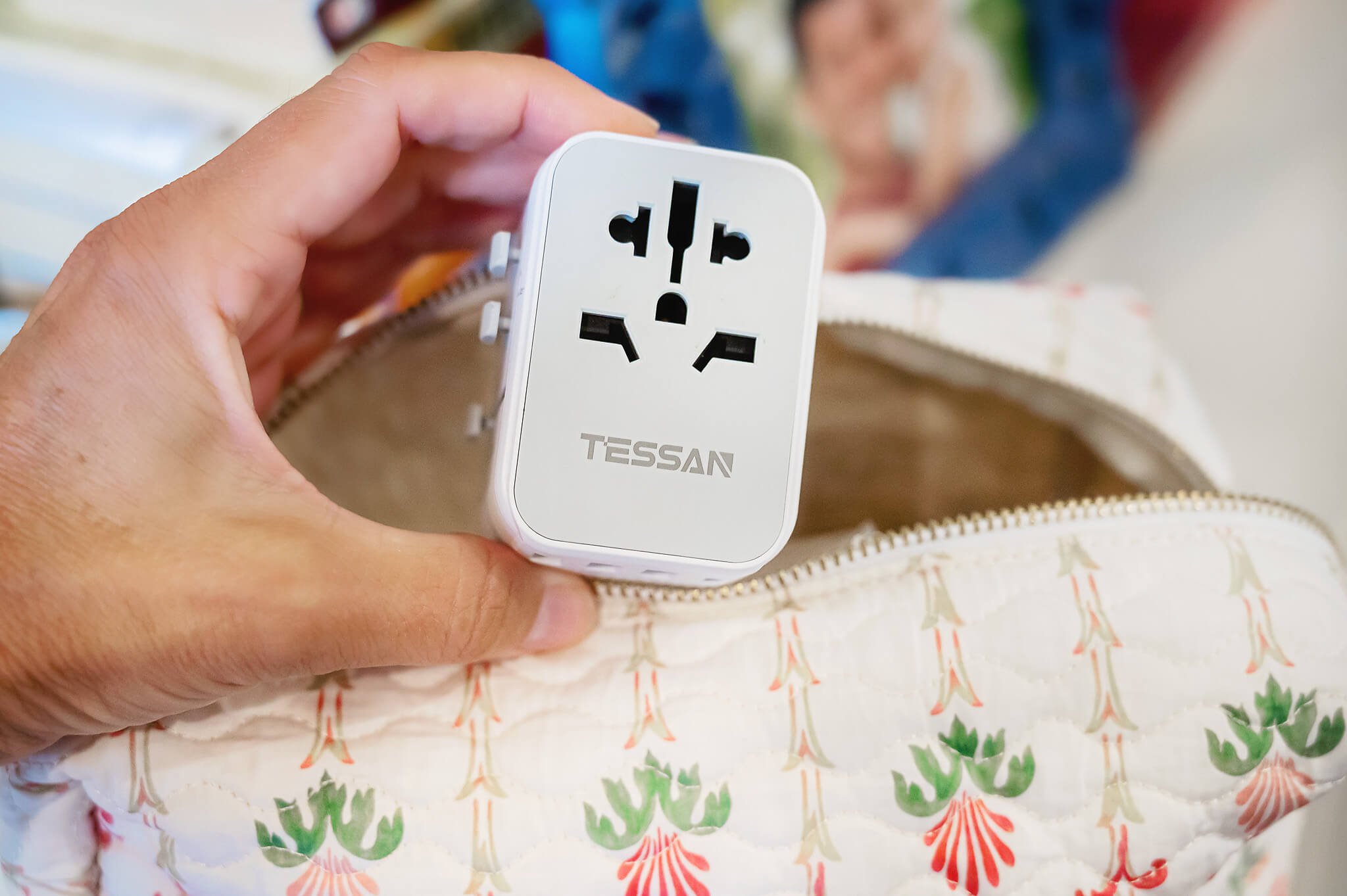
The Universal Travel Adapter I Use in Europe and the UK
When I first started traveling to Europe, I packed basic two-pronged European plug adapters. Those still work well for many trips, but they are limited to that single plug type.
So, now I use a universal travel adapter that can be used in various European countries, including the United Kingdom, and destinations beyond Europe.
Why I Prefer Universal European Plug Adapters
The biggest benefit of a universal travel plug adapter is flexibility. Many of our European trips include multiple countries, and sometimes the UK, Ireland, or an international connection that uses a different plug style. Instead of packing several individual adapters, I can bring one universal option.
It is also useful well beyond Europe. My universal adapter has a standard two-pronged U.S. plug, allowing me to use it as a compact charging station in American hotels, airport lounges, and even at home if I wanted to. I regularly pull it out at least once before the international portion of a trip begins.
A universal adapter is especially helpful when you pack carry-on only. It reduces the number of plugs and charging blocks you need while allowing several devices to share one outlet. Just remember that a universal travel adapter changes the plug configuration only. It does not convert voltage!
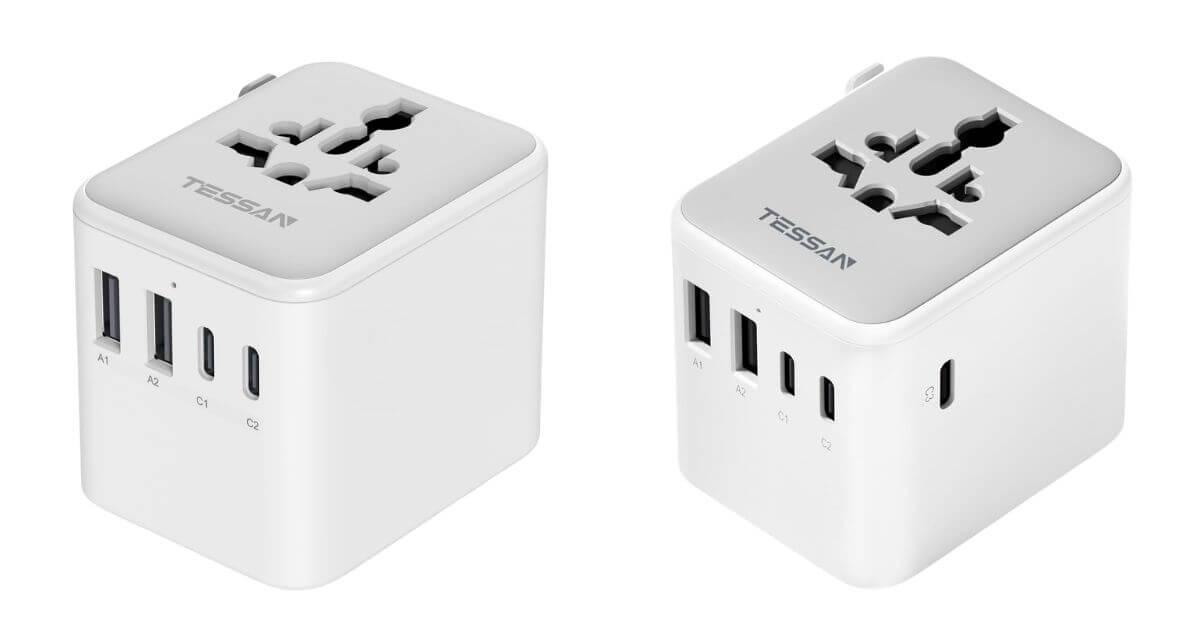

My TESSAN Universal Travel Adapter
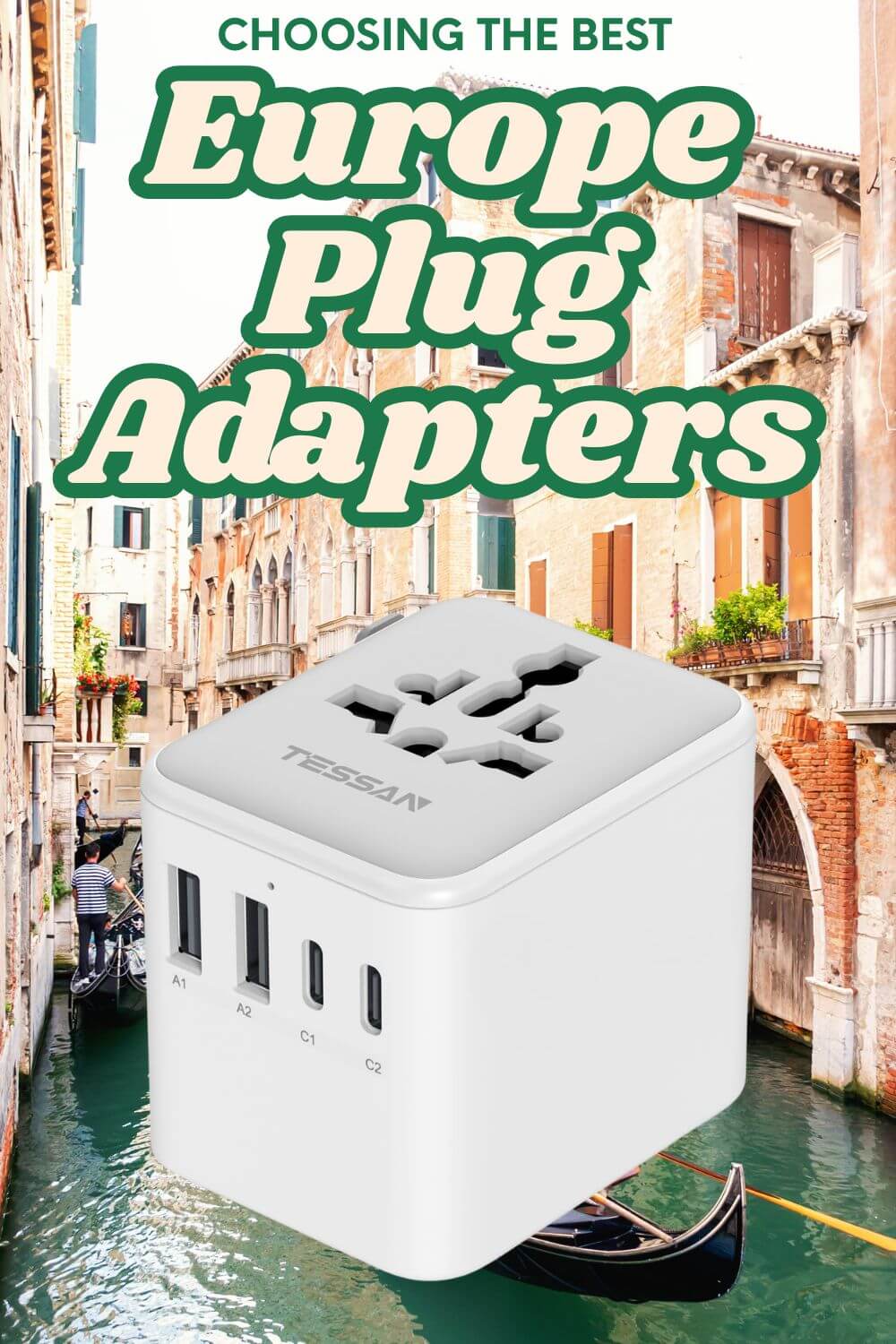
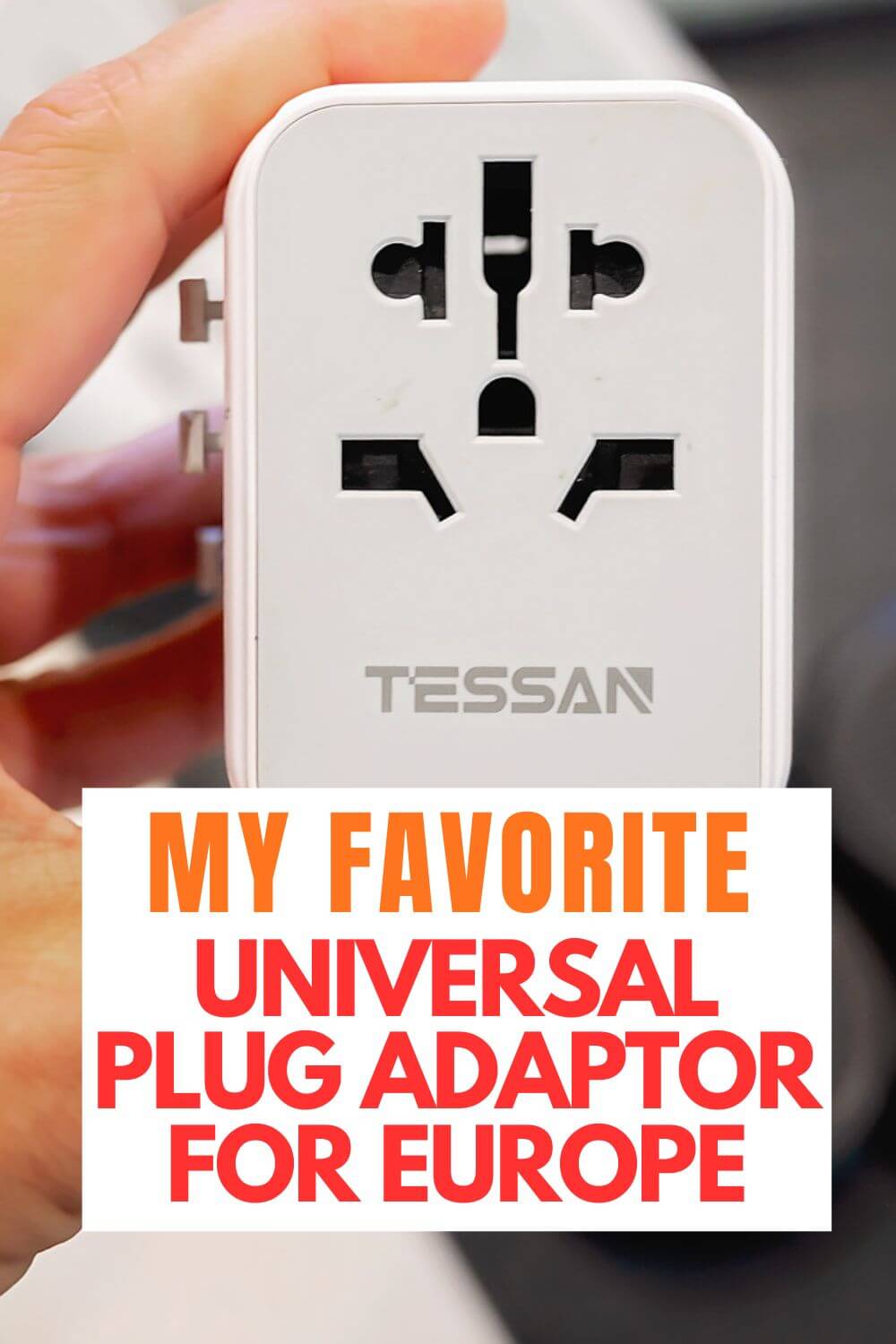
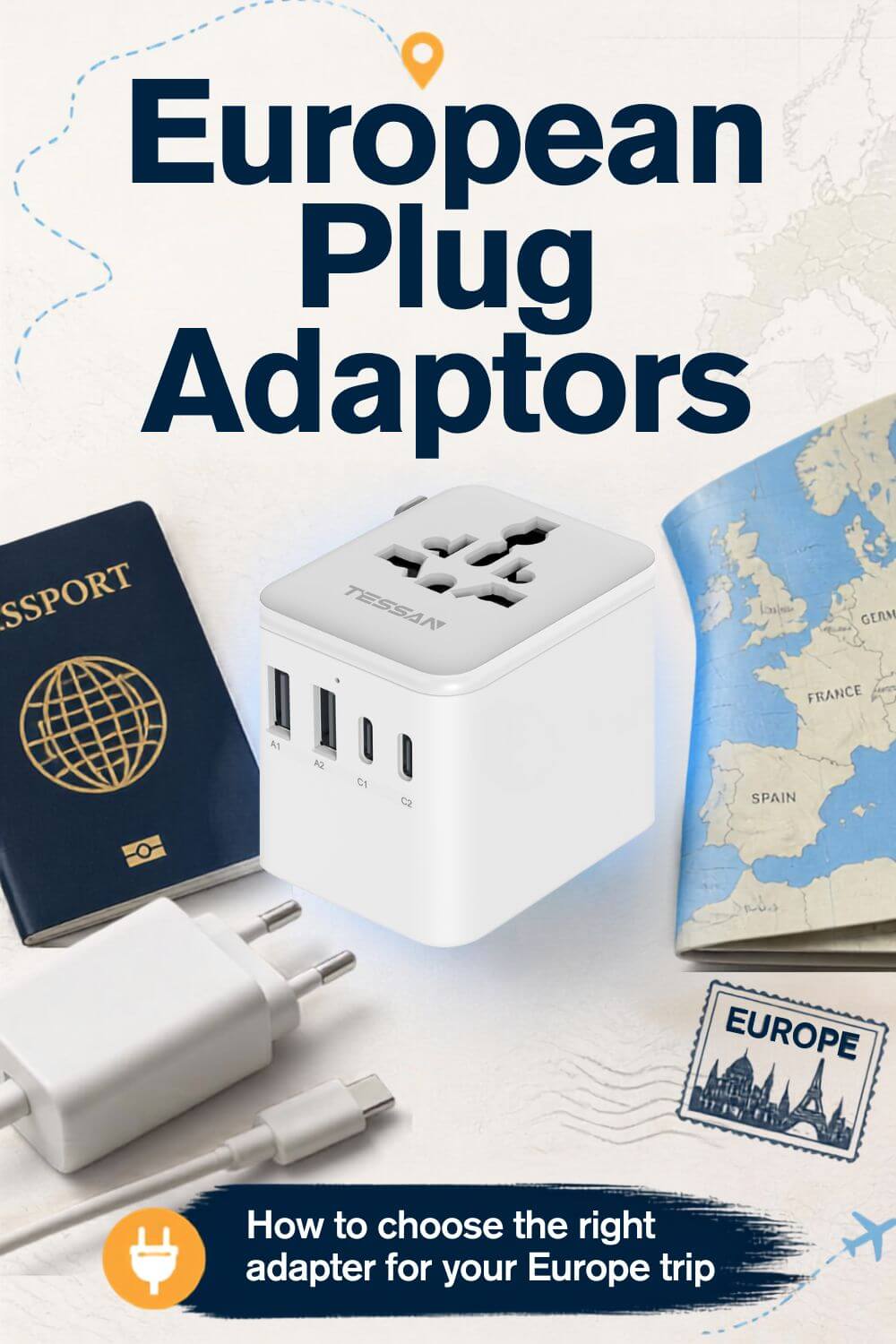
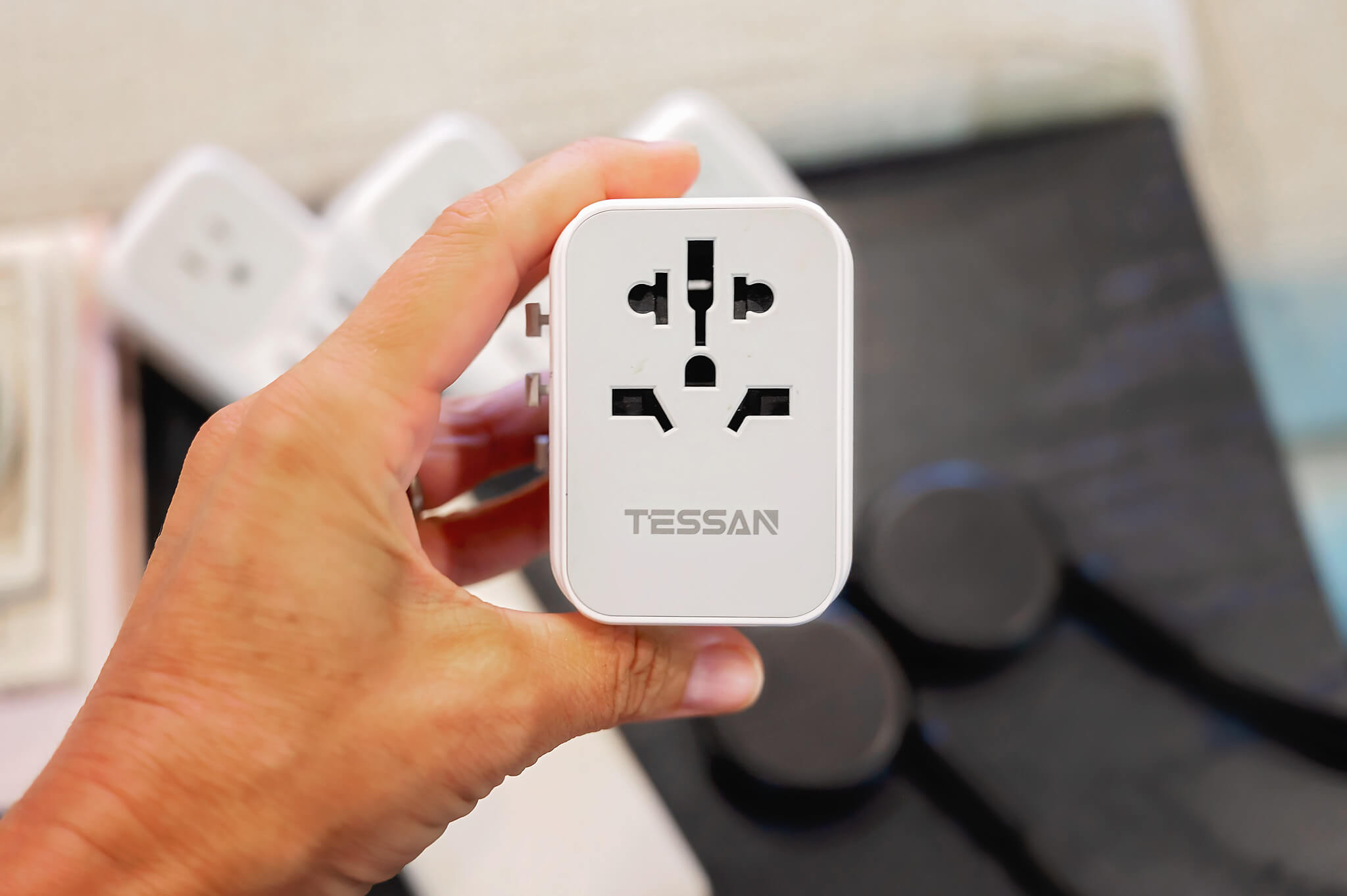
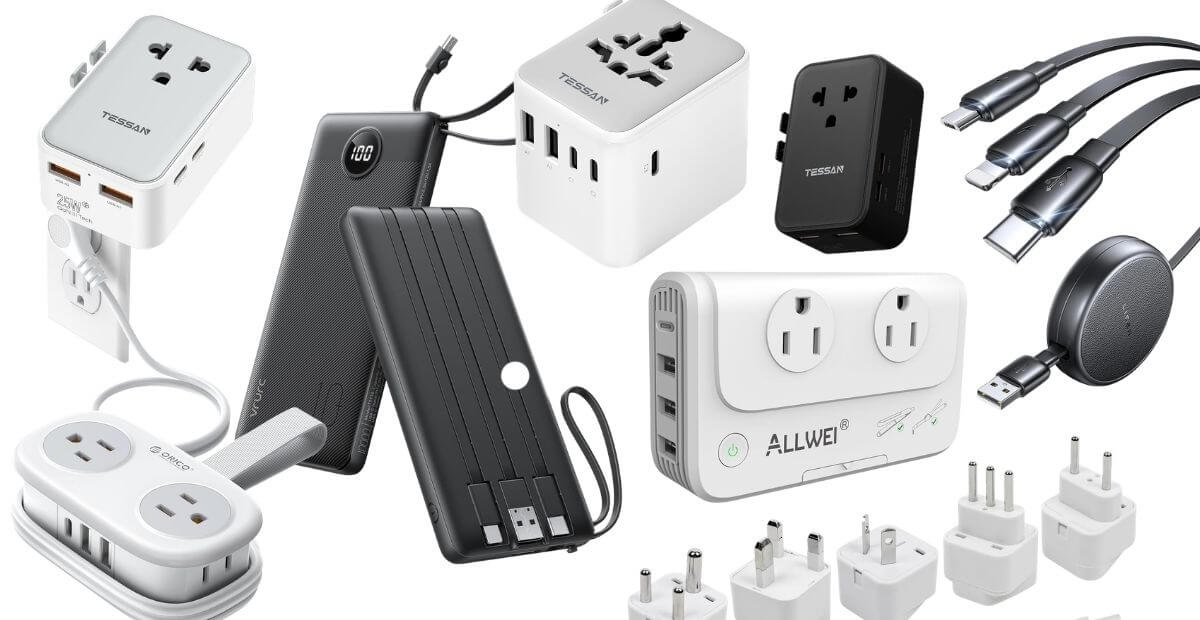
This TESSAN universal travel adapter is the model I currently own and use. Its built-in plug options include Type C for most of continental Europe, Type G for the UK and Ireland, Type I for destinations such as Australia, and Type A for the United States, Canada, and Japan.
It has one universal AC outlet, two USB-A ports, and two USB-C ports, allowing you to charge up to five devices at the same time. That is useful in European hotels and vacation rentals where conveniently located outlets can be limited. This allows it to act as a power hub and charging station for multiple devices, which is why we each carry one each when traveling abroad.
They also have an almost identical version for a couple of dollars more with a third USB-C plug.
The Newer Slim TESSAN Universal Adapter
TESSAN now makes a newer, slimmer universal travel adapter that is another great option. It includes the same major Type C, G, A, and I plug configurations, making it useful throughout most of Europe, the UK, and many other international destinations.
Like the model I currently use, the newer TESSAN is a universal plug adapter and charging hub. It still does not convert European voltage to U.S. voltage, which we will talk about next!
You can’t go wrong with either one. And, if I ever needed to buy a new European plug adaptor, I would probably grab the slim version next!

Plug Adapter vs. Voltage Converter: What Is the Difference?
Plug adapters and voltage converters are often confused, but they do two completely different jobs. A plug adapter helps your device physically connect to a European wall outlet, while a voltage converter changes the electrical voltage flowing into certain appliances.
Most travelers will need a plug adapter for Europe. Far fewer people need a voltage converter.
But when you do, you will know! I will always remember the smell of melting plastic in Santorini when Abby plugged my favorite hair straightener into the wall without using a voltage converter. We caught it quickly, but the straightener was already ruined!
What Do European Plug Adapters Do?
A European plug adapter changes the shape of your U.S. plug so it can fit into a European outlet. It does not change the voltage or alter the electricity in any way.
For example, a standard American phone charger has flat prongs, while most outlets in continental Europe use two round openings. A European plug adapter creates the physical connection between the two.
Plug adapters work well for most dual-voltage electronics, including:
- Phones
- Tablets
- Laptops
- Cameras
- Smartwatches
- Portable battery chargers
- USB charging blocks
As long as your device is designed to handle European voltage, you only need the correct plug adapter.
What Does a European Voltage Converter Do?
A European voltage converter changes the higher electrical voltage used in Europe to a lower voltage that certain U.S. appliances can safely handle.
Most European countries use approximately 220–240 volts, while standard outlets in the United States use around 110–120 volts. Plugging a single-voltage American appliance directly into a European outlet can damage the device, trip a breaker, or create a safety hazard.
Voltage converters are generally larger and heavier than basic plug adapters because they contain components that actually transform the electrical voltage.
Most European travelers do not need a voltage converter for phones, laptops, tablets, cameras, or other modern electronics. These devices are usually dual voltage, but you should always check each one before your trip.
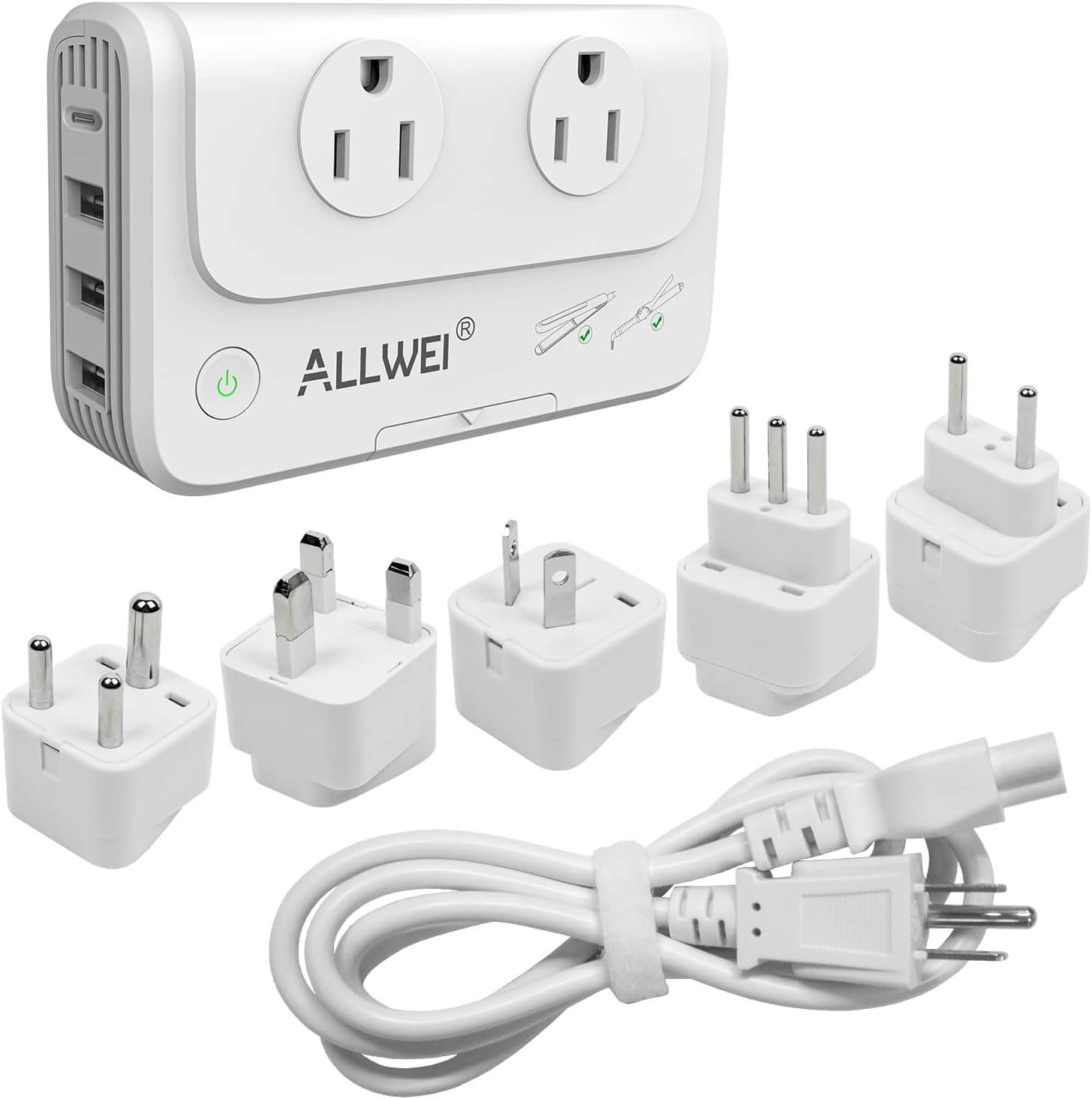
I use the ALLWEI International Travel Adapter 220V to 110V Power Voltage Converter, which comes with various plug adapters that plug into the wall outlet.

How to Tell Whether Your Device Is Dual Voltage
Before packing any electronic device or appliance for Europe, check the small label or printed specifications on the device, charging block, cord, or power supply.
A dual-voltage device will usually show an input range similar to: 100–240V, 50/60Hz
That means the device is designed to work with both U.S. and European voltage. You will still need the correct European plug adapter, but you will not need a voltage converter.
A single-voltage device may show something like: 110–120V
In that case, the device is not designed to handle standard European voltage without an appropriate converter.
Be sure to check every device individually rather than assuming all of your electronics are dual voltage. Pay particularly close attention to:
- Hair dryers
- Curling irons
- Flat irons
- Heated styling brushes
- Electric shavers
- Small travel appliances
Hair tools and other high-powered appliances are the most common sources of confusion because some are dual voltage and others are not. Always confirm both the voltage and wattage before connecting one to a European outlet.
Some of these devices, including certain hair dryers, are already dual voltage. They may include a switch that lets you select the correct voltage. See these dual-voltage hair tools as an example. See how they are labeled?
The Voltage Converter I Recommend
Most of our everyday electronics, including phones, laptops, tablets, cameras, and portable chargers, are dual voltage and only need the correct European plug adapter. However, I still travel with a voltage converter for certain single-voltage appliances and hair tools.
The model I use is the ALLWEI International Travel Adapter and 220V-to-110V Power Voltage Converter.
Which Plug Adapter Do You Need for Europe?
The European plug adapter you need depends on where you are traveling. Much of Europe uses two-round-pin plug systems, typically Types C, E, or F, although the grounding design and exact socket style vary by country. While the United Kingdom, Ireland, and a few other European countries use a different plug style.
A universal travel adapter is usually the easiest option, especially for multi-country trips, which is why I am recommending it in this post! Or, you can buy the single plug version for the specific country you will be visiting in Europe.
Plug Adapters for Most of Europe
Most of continental Europe uses outlets built around two or three round pins, typically Types C, E, or F, although the exact socket style varies by country.
Type C is the basic two-round-pin European plug.
Type E also uses two round pins but includes a grounding pin in the wall socket.
Type F (sometimes called a Schuko outlet) uses two round pins with grounding contacts along the sides.
You can think of C and E plugs as a parallel to standard two- and three-pronged US plugs and outlets. Some have the grounding pin, and some don’t. And the wall outlet sometimes only takes two-pronged, while others have the third grounding pin slot.
These European outlet types are common across European destinations such as:
- France
- Germany
- Spain
- Portugal
- Greece
- Austria
- Belgium
- (most of) Italy
- The Netherlands
- Croatia
- Norway
- Sweden
- Czechia
- Hungary
The exact outlet type varies slightly by country, and in many places you can use both. That said, a compatible universal adapter works across most of these destinations without requiring a separate plug for each one.



Plug Adapters for the United Kingdom and Ireland
The United Kingdom and Ireland use Type G outlets with three rectangular pins. This includes:
- England
- Scotland
- Wales
- Northern Ireland
- Republic of Ireland
A standard two-round-pin European adapter will not fit these outlets, which is one reason I prefer traveling with a universal adapter. We often connect and have layovers in London. So, the universal plug means that I don’t have to pack a separate Type G outlet adapter!


Other European Countries With UK-Style Plugs
Malta and Cyprus also use Type G outlets:
- Malta
- Cyprus
Travelers often overlook this because both countries are part of Europe, but they do not use the same round-pin plugs found across much of continental Europe. We spent Spring Break in Malta last year, and many people don’t realize that it was under British rule for a very long time. You can even see the iconic red phone booths dotted around Valletta.

European Countries With Additional Plug Considerations
A few European destinations use less common outlet styles. A universal adapter should still work, but it is worth checking your exact model before traveling.
Italy
Italy commonly uses Types C, E, F, and L. Many universal adapters work well there, making them more practical than buying an Italy-only adapter. And, most low-power devices still use the Type C plugs. I have traveled to Italy many times and pretty much always seen the Type C.
That said, older buildings can still have Type L, so pay attention. Be especially careful with grounded or high-powered appliances, as compatibility can vary by outlet.



Switzerland and Liechtenstein
Switzerland and Liechtenstein use Type J outlets. Slim two-pin Type C plugs generally fit Type J sockets, which means many standard European adapters work for basic electronics.
Larger grounded Type E or F plugs do not fit, so travelers using grounded appliances should choose an adapter specifically compatible with Type J. But most typical vacationers aren’t traveling to Europe with large grounded electronics.
Denmark
Denmark officially uses Type K outlets, but basic two-pin Type C plugs generally fit for charging small electronics. Grounded appliances may require a Type K-compatible adapter because standard grounded Type E or F plugs are not fully compatible.
For most travelers charging phones, cameras, and other small electronics, a universal travel adapter is still the simplest solution!
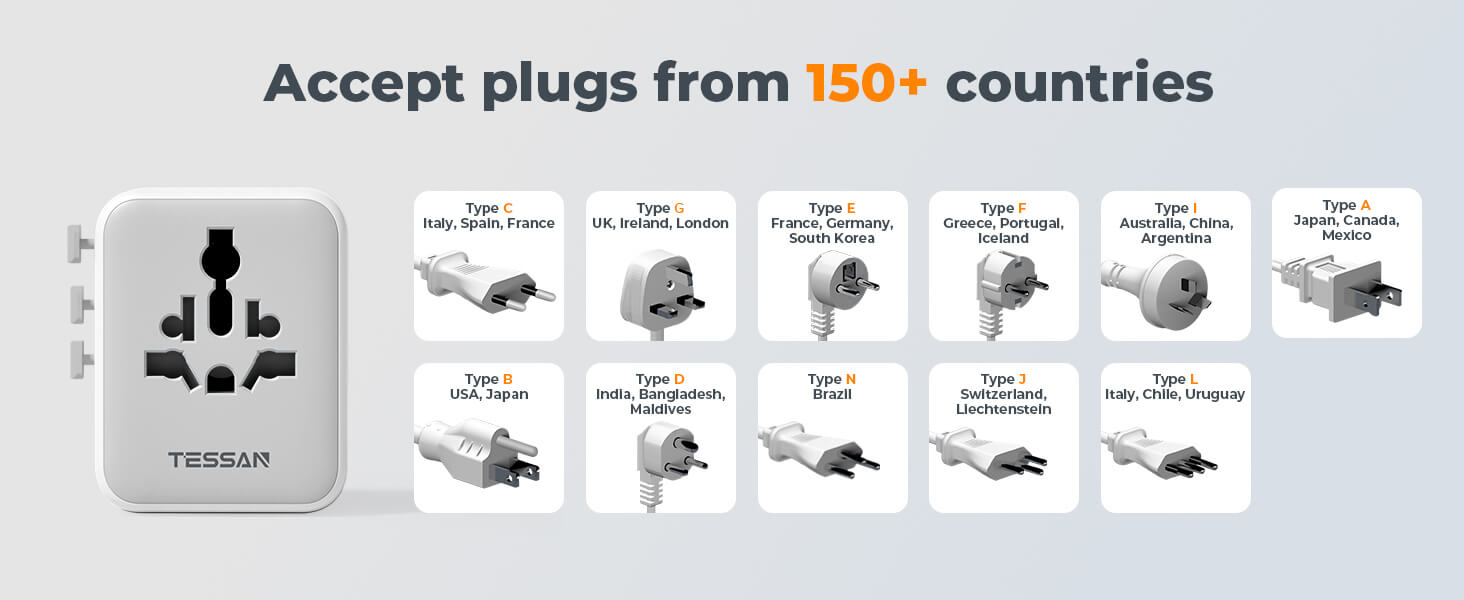
And while the plug going into the actual outlet is what we are talking about most of the time here, many universal plug adapters also take a wide range of input-style plugs, as you can see in the image below.

4 Tips for Charging Devices in Europe
A little planning goes a long way when you are charging several devices overseas. These are the habits that help our family avoid dead phones, crowded outlets, and last-minute problems while traveling in Europe!
#1 Pack More Than One Charging Option
Do not rely on one plug adapter for an entire family. Think about how many phones, watches, cameras, tablets, and laptops will need to charge each night.
Even when one universal adapter can charge several devices, having a second option gives you flexibility if outlets are spread around the room or someone needs to charge in a different area.
Typically, each family member has one near their bed for overnight charging multiple devices. Then I have one out on a desk for my computer, camera, backup chargers, etc.
#2 Check Your Devices Before Leaving Home
Check the voltage information on every device before your trip, especially hair tools and other higher-powered appliances. Also confirm the wattage and make sure it falls within the limits of your voltage converter.
I also recommend testing any new adapter, converter, cable, or charging block before you leave. It is much easier to replace something at home than after arriving in Europe!
#3 Do Not Overload Your Adapter
Always follow the power and wattage limits listed by the manufacturer. A universal adapter may have several ports, but that does not mean it can safely support several high-powered appliances at the same time.
Use the USB ports for phones, Apple watches, and other small electronics, and avoid plugging multiple hair tools or other high-wattage devices into one adapter or extension cord.
#4 Keep an Adapter in Your Personal Item
I always keep at least one universal adapter in my personal item instead of packing every charging option in checked luggage.
That makes it easy to charge during an airport connection or in an airport lounge. It also means you can power your devices as soon as you arrive, even if your checked bag is delayed.


Additional Travel Charging Essentials I Pack for Europe
Beyond a universal plug adapter and voltage converter, I pack a few simple charging accessories that make travel days and hotel stays much easier. These are items that I bring to Europe, but also on all of our domestic trips!
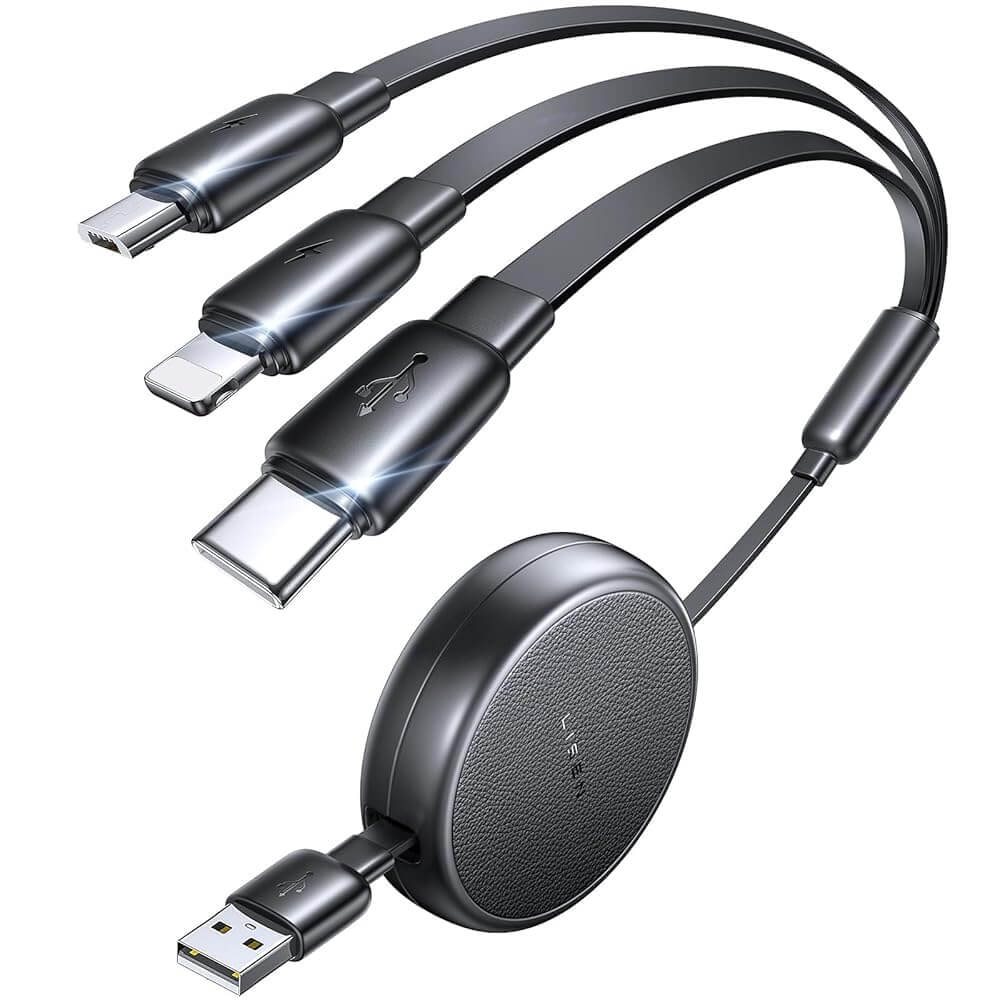
Retractable Multi-Charging Cables
I always travel with two retractable multi-charging cables. They are useful for charging phones, tablets, headphones, portable batteries, and other small devices without packing a separate cord for each one.
I use them constantly on airplanes, in airport lounges, in rental cars, and on hotel room nightstands. The retractable design also keeps cords from becoming tangled in my travel bag.
These cables add more charging connections, but they do not create additional electrical outlets or convert voltage. They still need to connect to a compatible USB port or charging block. That said, many hotel nightstands and airplanes use the larger USB port, making these super helpful!
A Compact Travel Extension Cord
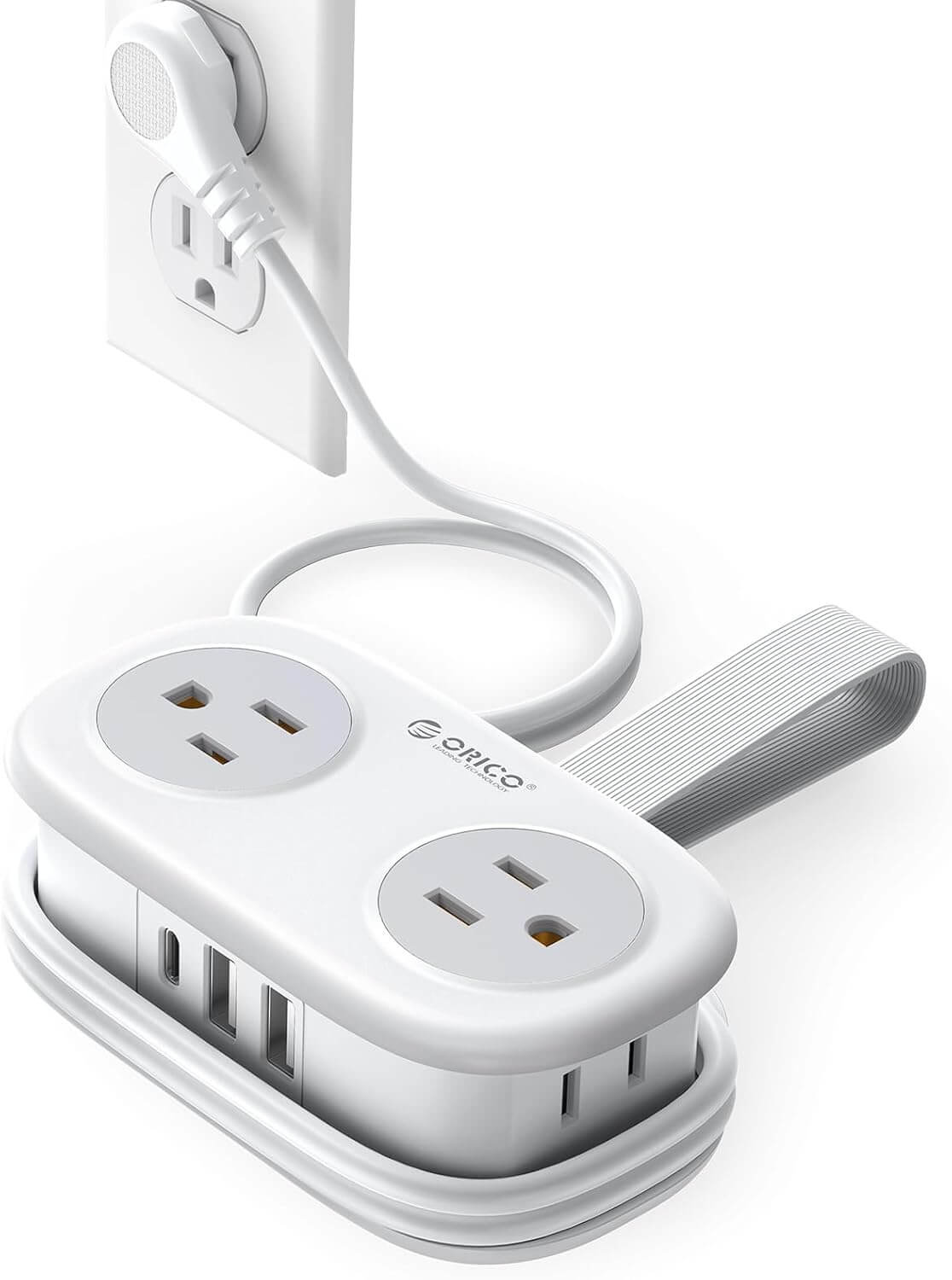
We also travel with this compact wrap-around extension cord, and it is especially useful in hotel rooms where the outlets are behind furniture or too far from the bed.
It adds multiple AC outlets and USB charging ports, making it a helpful option for families or anyone traveling with several devices. The cord wraps neatly around the unit, so it stays relatively compact in a suitcase or carry-on.
Keep in mind that a travel extension cord does not convert voltage. When using it internationally, you still need to plug it into the correct European adapter, and every connected device must be compatible with the local voltage.
Portable Power Banks
I recommend carrying a portable power bank on every trip, not just international ones. Long sightseeing days, flights, train rides, and excursions can quickly drain your phone battery.
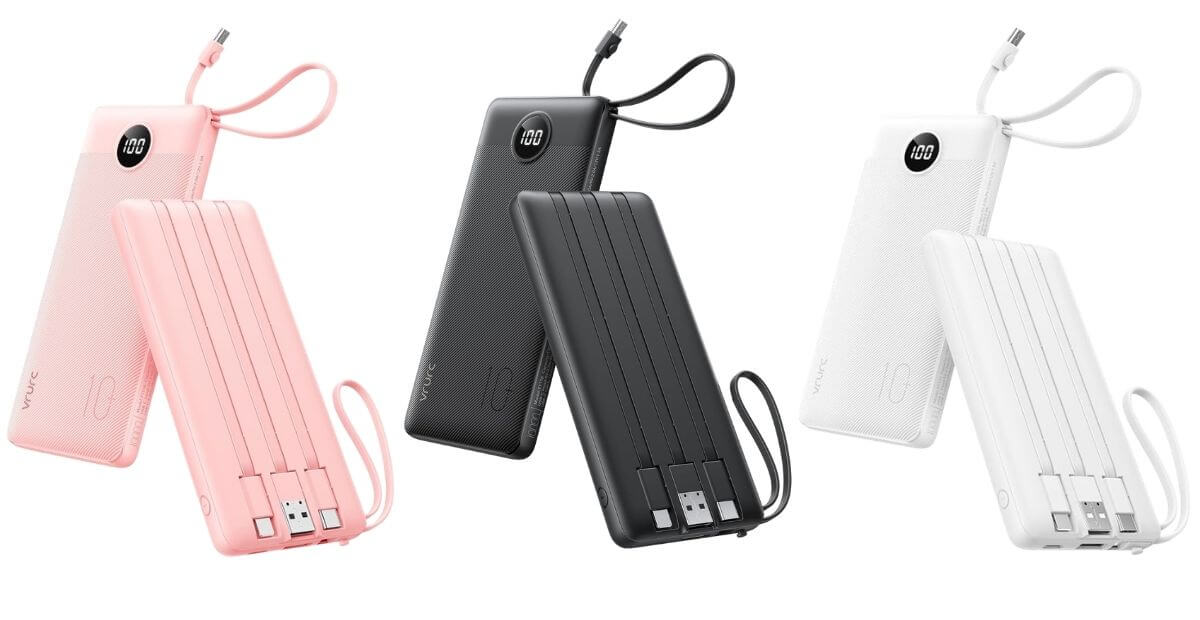
We rely on our phones for navigation, photos, boarding passes, mobile tickets, restaurant searches, and transportation, so I never want to be stuck without power. I especially like portable chargers with built-in cables because they eliminate the need to dig through my bag for another cord.
I usually leave the hotel with both a fully charged phone and a fully charged backup battery.
My favorite portable power bank is the VRURC Portable Charger, Built-in 4 Cables Slim Power Bank 10000mAh, and I can get a few full charges out of it while we are out and about on a travel day!
TIP: Buy everyone a different color to help ensure people (teenagers) are responsible for charging their own.

My European Travel Charging Setup
For most trips to Europe, this is the simple charging setup I recommend packing:
- Universal TESSAN travel adapter
- A voltage converter if needed
- Retractable multi-charging cables
- One compact extension cord
- Portable power banks
This gives you enough flexibility for hotels, vacation rentals, airports, trains, and long sightseeing days without taking up much room in your carry-on. You have everything you need, and nothing you don’t need!

More Europe Travel Essentials & Tips
Planning a trip to Europe? My firsthand travel guides can help you pack smarter, find better travel deals, and make the most of your time abroad!
You can also browse all of my Europe travel content for first-hand destination guides, practical planning tips, hotel reviews, itineraries, transportation advice, and travel inspiration from nearly 20 European countries.
Here are some other posts you may enjoy!
- Europe Travel Essentials
- International Travel Tips
- Finding Flight Deals
- Airport Parking Hack
- Europe Family Photos
- Airport Lounge Access
- Using Points & Miles
- Europe Walking Shoes
- AirTags for Travel
- Travel Garment Steamer
And follow along on social media! Later this week, Matt and I are heading to Italy, Croatia, and Montenegro on a Star Clippers cruise. I can’t wait to share that experience with you!
PIN: European Plug Adapters for Later