We may earn money or products from the companies mentioned in this post. As an Amazon Associate, I earn from qualifying purchases.
Last Updated on July 22, 2026 by Sarah
While there are several different Airbnb cancellation policy options, not every policy works well in every short-term rental market. A more flexible cancellation policy may sound appealing at first, but many experienced Airbnb hosts eventually realize it can lead to more last-minute cancellations and harder-to-fill calendar gaps.
My new Airbnb hosting guide breaks down Airbnb’s four standard cancellation policies for shorter stays, explains how each works, and explains why I personally use the Firm cancellation policy at all four of my vacation rentals in Florida.
And, new in 2026, Airbnb is now offering an additional free cancellation option to the guest at checkout. I am actually a huge fan of this as an Airbnb host! More on that below.
And if you are just starting your Airbnb hosting journey, read my Ultimate Airbnb Setup Checklist and grab a printable version, too!
Understanding Airbnb Cancellation Policies
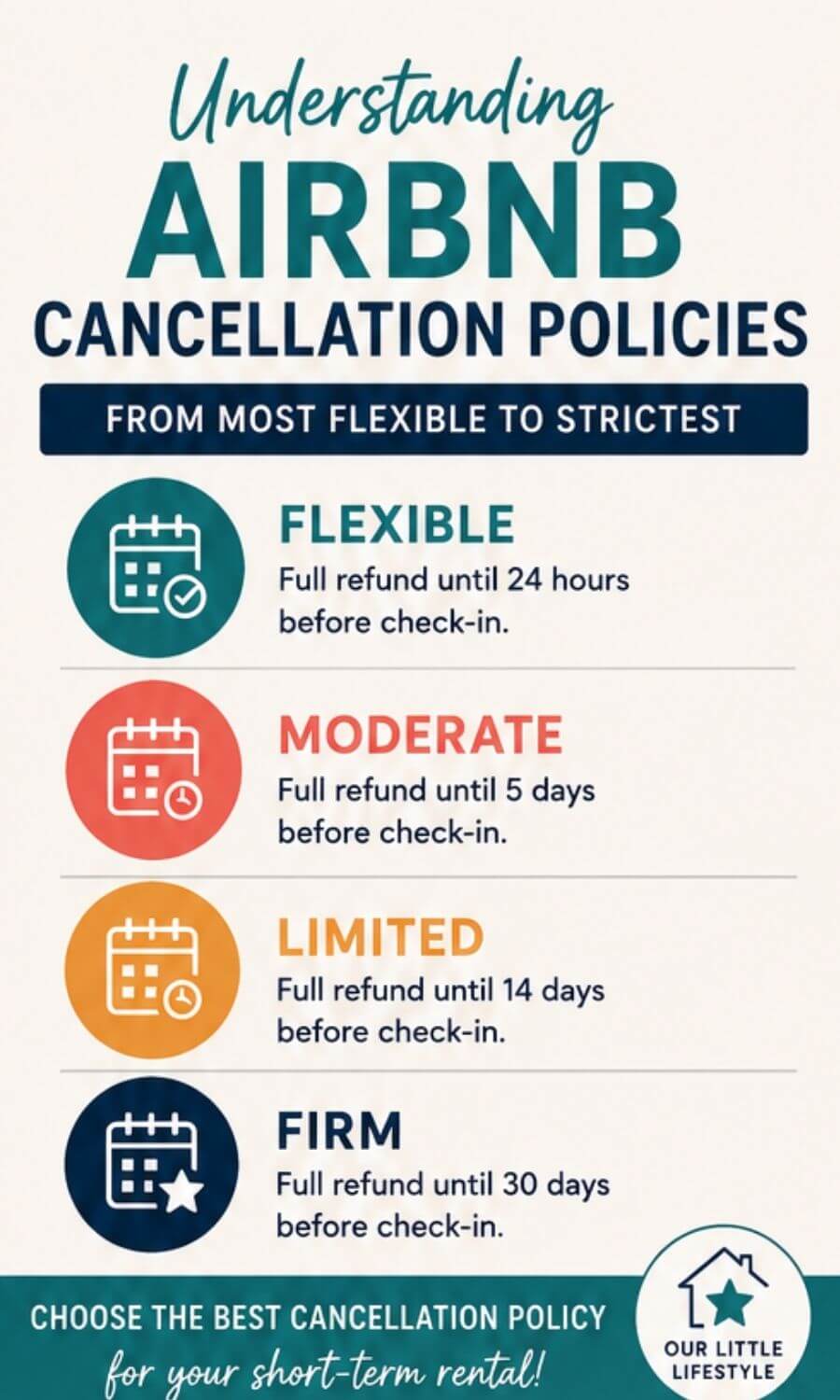
For short-term rental stays under 28 days, Airbnb currently offers four different cancellation policies for Airbnb hosts to choose as the standard cancellation policy on their Airbnb listings:
- Flexible
- Moderate
- Limited
- Firm
There are a few older options grandfathered in and a different set of policies for longer stays (28+ days), but today the focus is on short-term rentals.
That said, just like with most air travel, Airbnb guests can cancel within 24 hours of booking for a full refund if the reservation was made at least 7 days before check-in.
I actually like this policy because, on many occasions, guests don’t read through our entire listing before making an instant booking (yes, I still recommend you allow instant booking, too). So, when our studio condo, which accommodates two adults plus up to two young kids, gets a booking for four adults, I can quickly let them know that our place won’t work for them. Then they can cancel right away with neither of us being penalized.
That said, if they don’t respond or cancel in time, I have always been able to call Airbnb, and as long as things are clearly listed in our booking and House Rules, they have been able to initiate a cancellation for me without penalty.
But let’s jump in now and talk about the actual Airbnb cancellation policies so that you can better understand your options. These are in order from the most flexible to the strictest. All of this info can be verified directly on Airbnb’s own cancellation policy page.
Flexible Airbnb Cancellation Policy
How it works:
- Full refund until 24 hours before check-in
- After that, hosts are paid for nights stayed plus one additional night.
At first glance, the Flexible Airbnb cancellation policy sounds very guest-friendly. And, it definitely is! But, it’s not very host-friendly!
In some markets, especially urban rental or business-travel destinations, it may work just fine. Personally, I would never use this policy at our Florida beach vacation rentals. In seasonal destinations, guests often cancel at the last minute because the weather forecast suddenly looks less than perfect. Or, maybe they just don’t feel like going anymore.
It’s nearly impossible to rebook these last-minute Airbnb cancellations!
Moderate Airbnb Cancellation Policy
How it works:
- Full refund until 5 days before check-in
- After that, hosts receive payment for nights stayed, one additional night, and 50% of the remaining nights.
For me, five days out is still going to be really difficult to rebook. So, my same comments from above apply here, too. Even worse, the 5-day weather forecast for a vacation destination like the 30A beaches in Florida can look grim, only to change by the day of arrival.
Limited Airbnb Cancellation Policy
How it works:
- Full refund until 14 days before check-in
- 50% refund between 7 and 14 days before check-in
- No refund under 7 days before check-in
I think this policy makes a little more sense for some rentals than Flexible or Moderate. Two weeks gives Airbnb hosts at least a little time to rebook canceled dates while still giving guests some flexibility.
But it’s really not that different from the last one, and two weeks is still cutting it close to me, especially when I have already spent time putting together custom recommendations and answering questions leading up to the stay.
That said, if maximizing occupancy and predictable revenue isn’t your top priority, I can understand why some hosts choose this option.
Firm Airbnb Cancellation Policy
How it works:
- Full refund until 30 days before check-in
- 50% refund between 7 and 30 days before check-in
- No refund under 7 days before check-in
This is the cancellation policy I personally use at all four of our Florida vacation rentals. We typically run at 100% occupancy during the peak and shoulder seasons, booking most rentals two to four months in advance. Knowing that my next 30 days of bookings are good to go gives me real peace of mind!
In the following section, I will share in detail about why I chose this Airbnb Cancellation Policy and recommend that other business-minded hosts do the same.
Why I Personally Use the Firm Airbnb Cancellation Policy
Vacation rentals are hard to rebook at the last minute! And honestly, I don’t want my family to become the travel insurance provider for someone’s vacation.
What do I mean by that?
It’s just how it sounds. I don’t want my family to personally insure a guest’s trip, and that is essentially what happens when I allow extra-flexible Airbnb cancellation policies. We aren’t a big corporation, and when guests cancel at the last minute and I am unable to rebook, it comes out of my family’s pockets.
But can guests book my place and still be protected?
Absolutely! Guests still have options to protect themselves. Airbnb offers travel insurance at the time of booking that reimburses up to 100% of your Airbnb reservation cost if a guest needs to cancel for a covered reason, such as illness or a weather-related flight cancellation. Read more about that here.
Also, many travelers carry their own travel insurance policies, including options with robust “cancel for any reason” (CFAR) coverage for those who value total flexibility in their travel plans. Plus, many premium travel credit cards, including those I mention in my Points & Miles Guide, offer built-in travel protection!
In fact, I even include travel insurance among the 9 extra services I like to tell my guests about!
Personally, I would rather keep my pricing simple, use a Firm cancellation policy, and be done with it. If guests want more flexible cancellation options, they may be better off booking a refundable hotel rate or choosing a short-term rental with a looser cancellation policy.
READ: Airbnb vs Hotel: When To Choose One Over the Other
The New Airbnb Extended Cancellation Add-On for Guests
I wrote this post before Airbnb announced, in mid 2026, that they are rolling out a new extended cancellation option for guests to add on at booking. So, not only does this keep my advice the same, but I’m even more excited about it!
As you can see in this screenshot from my own listing with a sample stay in October, they are offering guests the option to essentially cancel for a full refund (minus the extended cancellation charge) up until 24 hours prior to check-in for $306.
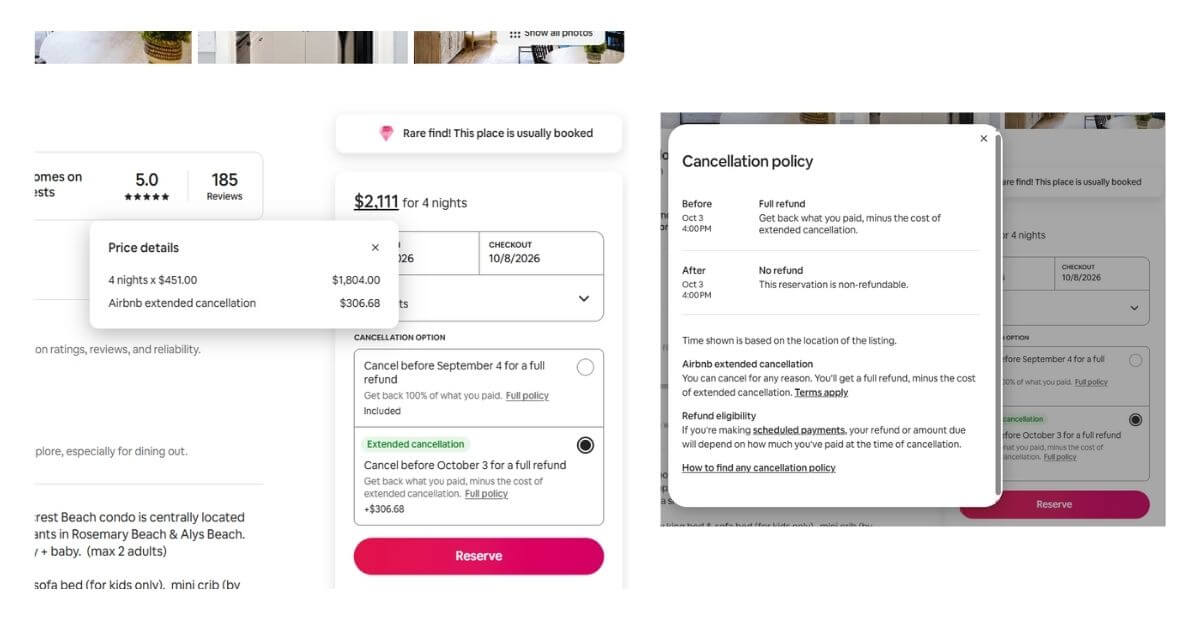
So, because I have the 30-day firm cancellation policy, if the guests were to cancel before Sept 3rd (30 days out), they aren’t penalized; I simply lose the booking, and my calendar opens up as it always has.
However, if they cancel in that final month and purchased the extended cancellation, then they get a refund (minus the $306 they paid for the extended cancellation). Airbnb still pays me, and my calendar opens up, allowing me to try to get another booking.
As a host, I see this as a huge win! Now, when last-minute cancellation requests come through, instead of asking them if they bought travel insurance, we can ask if they bought the extended cancellation policy. If they didn’t, that’s on them!
How much does it cost? Well, I am not sure of that! I tested a bunch of scenarios and dates, and it seems like it’s around 10%-20%. Interestingly, I did put in dates further out, and it didn’t give the option for the extended cancellation policy at checkout.
So, I hope once they roll this out to more people, we get a little bit more information. But, as of now, these are the official Airbnb policy pages for the extended cancellation option:

Should You Offer Airbnb’s Non-Refundable Booking Option?
Airbnb also allows hosts to offer a non-refundable booking option at about a 10% discount. In exchange for the lower price, guests give up some of their refund flexibility.
Personally, I don’t use this option at any of our vacation rentals either.
Why?
Honestly, most guests never cancel or plan to cancel anyway. And in my experience, the guests trying hardest to save that extra 10% are often the same guests who later message asking for an exception to the cancellation policy.
To me, it just creates more awkward refund conversations and unnecessary complications. I would rather keep my pricing straightforward, use a Firm cancellation policy, and set very clear expectations from the beginning.
At the end of the day, I think my current Airbnb cancellation policy plus the new option for extended cancellation and personal travel insurance already provides enough structure and protection for both sides.

What to Do When Guests Ask for a Cancellation Exception
Regardless of your cancellation policy and how attentive a host you are, you will eventually encounter guests who want to cancel anyway. And, they want a full refund. From my experience, these situations can quickly become emotional and stressful.
Upon getting these requests, I start by saying something along the lines of:
I’m so sorry that you need to cancel! The deadlines and refund amounts that you see for your Airbnb booking are firm. Did you purchase Airbnb’s insurance or extended cancellation policy at checkout? Or, do you have your own travel insurance? I am happy to help in any way you need me to for your claim.
From there, it’s pretty much always a no, and often, for the sake of all Airbnb hosts, it’s important to remember that exceptions can become expectations. It’s here that guests will often still ask for refunds outside the cancellation window. Emotional pressure is common. But consistency matters, and as Airbnb hosts, it’s important to have boundaries.
Situations Where You May Consider an Exception
Of course, I am not heartless! I know there are situations where it makes sense to let them cancel and get a refund. These include things like major emergencies and a death in the family.
But to be blunt, most travel insurance covers these situations, so I always go that route first, even asking whether they paid with a card that offers travel insurance, such as the Chase Sapphire Reserve or the American Express Platinum.
There is the option of asking them to move to new dates. But if it’s more than 30 days out, then they could just cancel that one. So, it’s not really worthwhile for me to require that.
Situations Where I Usually Stick to My Policy
Major weather disasters, such as named hurricanes, are, of course, an exception. But, if it’s just a rainy or overcast forecast, I don’t. Just this past weekend, it was set to rain every day. It poured Saturday morning, but my afternoon was clear, and Sunday in Rosemary Beach was sunny and gorgeous!
Other things, such as schedule changes or guests changing their minds, just aren’t situations where it makes sense to make an exception to my cancellation policy.
READ: How to Prepare for Emergencies at Your Rental
A Compromise Some Airbnb Hosts Use
All of this said, there are certainly times when a guest is friendly, has a unique situation, and is trying to cancel. Even with my Firm Airbnb cancellation policy, they can still get a 50% refund up to 7 days before check-in. So, on occasion, I have told guests I could offer a partial refund if I could rebook it. This is honestly a hassle, so I only do this if they are very friendly.
It’s very important to communicate this effectively! So, let’s say it’s 6 days out and they want to cancel but aren’t allowed any refund, I say something along the lines of:
As soon as you cancel the booking, it will open up my calendar and refund you the taxes. I will do my absolute best to rebook it. Since it’s last-minute, I will likely have to discount it. But if I can rebook any of it, I can pass along a partial refund of my base nightly rate at whatever I can rebook it at. I am unable to refund your Airbnb service fees. But the sooner you cancel, the better my chances of rebooking it!
Most of the time I have done this, it was only a day or two out, and I was unable to rebook it. A few times, I was able to rebook it, and just did a “send money” for whatever I was able to recoup of my base nightly rate. This is literally just your payout for those nights. You don’t want to end up reimbursing Airbnb fees and losing money in this scenario.
So, what I don’t do is offer future stay credits or solutions that aren’t easy to implement via the Airbnb platform, and we exclusively host on Airbnb.
QUICK LINK: Are you ready to create your new Airbnb listing? Click here to get started on Airbnb!
Which Airbnb Cancellation Policy Is Best For Your Short-Term Rental?
So, that is exactly how I run my Airbnb rentals. Everyone’s situation is different, and what works best for me may not work best for you. That said, this is how I support my family, and I need to maintain consistent boundaries that minimize last-minute disruptions. So, the Firm Airbnb Cancellation policy works best for me!
And, with the extended cancellation policy add-on rolling out in 2026, it allows the guests to share in some of that last-minute cancellation risk!
So, examine your Airbnb hosting business and consider how important consistent revenue is to you. How much do you value being able to look at your calendar and upcoming earnings 30 days out and know that money will most likely all make it into your bank account?
And, for the most part, most guests rarely even cancel 30 days out. On occasion, I have had some people book 6+ months out, not really communicate, and then cancel at day 31. They likely set a calendar reminder or received an email about an upcoming payment from Airbnb. In some cases, they may have forgotten about the booking entirely, while others simply use that 31st day to keep shopping for other options.
Choose the vacation rental cancellation policy that works for you, and you can always change it. Any changes would apply to new bookings moving forward, but it’s not set in stone.
One of the biggest parts of Airbnb hosting is being flexible, listening to guest feedback, and gaining experience. Over time, your own experiences will help you determine what works best for your Airbnb rental property!

More Airbnb Hosting Resources
If you found this Airbnb hosting guide helpful, make sure to explore more of my Airbnb tips and resources for short-term rental hosts. From setting up your first Airbnb property to managing guest communication, pricing, cleaning, and stocking your rental, I share exactly what has worked for us after years of hosting thousands of Airbnb guests at our Florida vacation rentals.
And if you are just getting started, don’t miss my Ultimate Airbnb Setup Checklist, where I break down everything you need to launch and stock your Airbnb rental property successfully.
I also highly recommend joining my Airbnb Hosting Facebook Group, where hosts can ask Airbnb questions, share first-hand hosting experiences, and learn from one another as they grow their short-term rental businesses.
Here are some popular Airbnb Hosting posts that you may enjoy:
- Best Airbnb Bedding
- Top Airbnb Essentials
- Airbnb Sofa Guide
- How to Earn Superhost
- My Top Calendar Tips
- Airbnb Mattress Protectors
- Airbnb Kitchen List
- My Airbnb House Manual
If you love to travel, follow Our Little Lifestyle on social media for first-hand travel tips and travel inspiration! One of the best things I ever did was setup my rentals in a way that allows me to easily manage them on the go, which truly helps me protect my peace as an Airbnb host!
Pin Best Airbnb Cancellation Policy for Hosts